
The world is still reeling from the aftermath of the Covid pandemic, as companies have shifted to new ways of working, adopting technologies to suit those working remotely or sometimes in different regions. According to a new study from the Confederation of British Industry (CBI) conducted with 250 companies, 67% of businesses across the United Kingdom have unfilled digital vacancies and less than a third (31%) are confident that the UK business community will be able to access the digital skills they need in the next 3-5 years. This is as a result of tech skills becoming more and more in demand across the UK. Therefore, to meet the expanding demand for digital technology skills, employers have to attract a wider talent pool.
Lets talk about neurodiversity
“Neurodiverse (ND) and neurodiversity refer to the infinite variation in cognitive functioning that can lead to differences in thinking, attention, and memory.”
Most people are neurotypical, which means the brain functions and processes information in a conventional way. Some people are neurodivergent, which means the brain functions, learns, and processes in alternative ways.
Neurodivergent individuals often have the skills employers need for digital tech roles, such as:
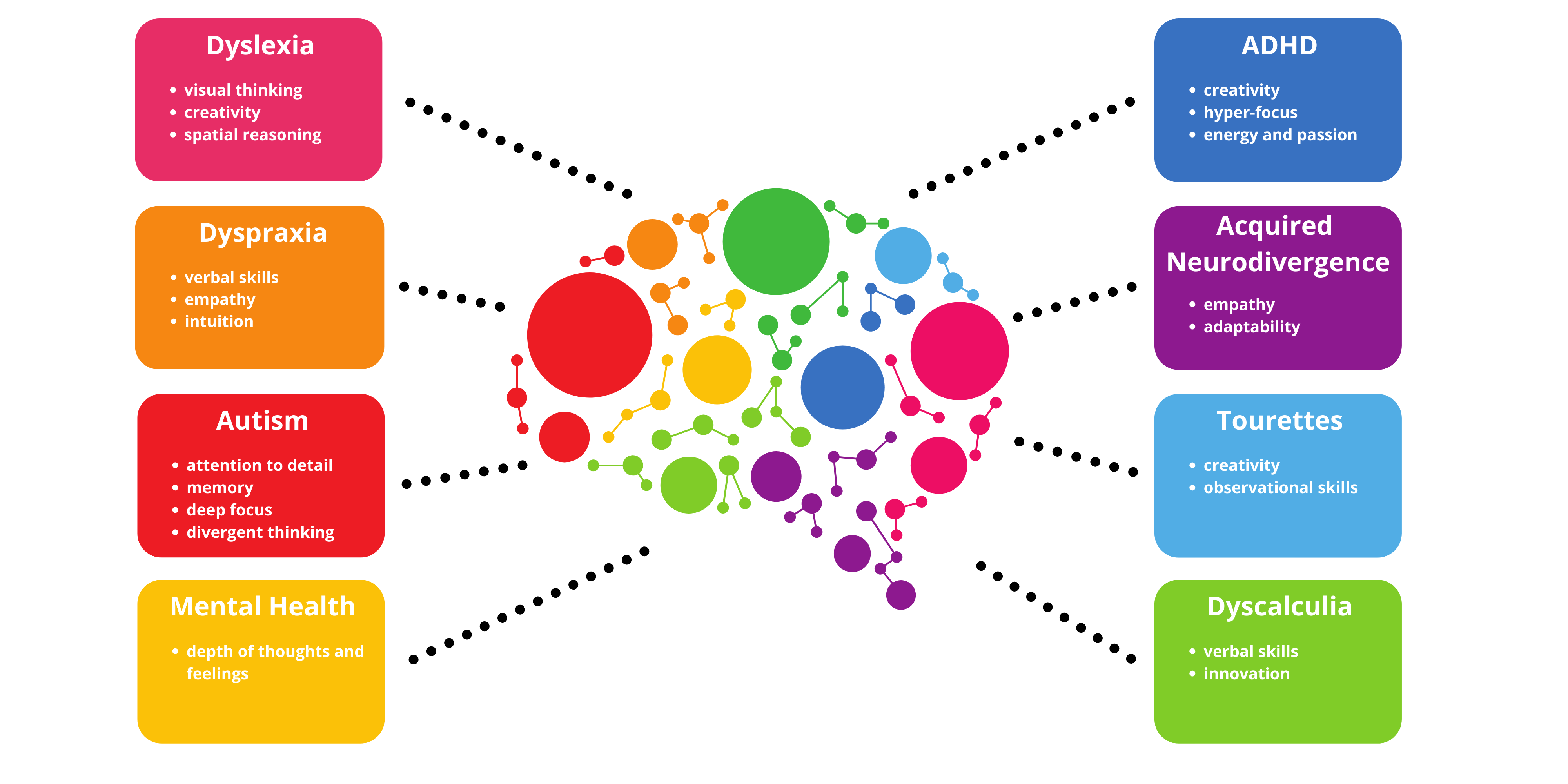
There is a huge untapped pool of neurodivergent talent keen to bring their sought-after skills to data analytics, cyber security, gaming, coding, design and much more in digital tech. The conditions listed below are all part of diagnostic labels used to explain the diverse ways of thinking, learning, processing and behaving. As with all people, we each have our talents and challenges.
It is commonly referred to as autism or, in the context of a professional diagnosis, as autism spectrum disorder (ASD), but the latter term remains controversial among neurodiversity advocates, neurodiversity researchers, and many autistic people due to the use of the word disorder and due to questions about its utility outside of diagnostic contexts.
Attention deficit hyperactivity disorder (ADHD) is a condition that affects people’s behaviour. People with ADHD can seem restless, may have trouble concentrating and may act on impulse.
Symptoms of ADHD tend to be noticed at an early age and may become more noticeable when a child’s circumstances change, such as when they start school.
Most cases are diagnosed when children are 3 to 7 years old, but sometimes it’s diagnosed later in childhood. Sometimes ADHD was not recognised when someone was a child, and they are diagnosed later as an adult.
The symptoms of ADHD usually improve with age, but many adults who were diagnosed with the condition at a young age continue to experience problems.
Dyspraxia, also known as developmental co-ordination disorder (DCD), is a common disorder that affects movement and co-ordination.
Dyspraxia can affect your co-ordination skills – such as tasks requiring balance, playing sports or learning to drive a car. Dyspraxia can also affect your fine motor skills, such as writing or using small objects.
Dyslexia is a common learning difficulty that mainly causes problems with reading, writing and spelling. It’s a specific learning difficulty, which means it causes problems with certain abilities used for learning, such as reading and writing.
It’s estimated up to 1 in every 10 people in the UK has some degree of dyslexia.
Dyslexia is lifelong and can present challenges on a daily basis, but support is available to improve reading and writing skills at school and work.
Dyscalculia is the name given to difficulty in learning about, comprehending or using numbers.
Such people will have difficulty in undertaking mathematical calculations such as adding, subtracting, multiplying and dividing, and can often find they also have difficulty understanding money, time, distances, directions and so on.
Illegible handwriting is a common sign of dysgraphia, but not everyone with messy penmanship has the disorder. It’s also possible to have neat handwriting if you have dysgraphia, though it may take you a long time and a lot of effort to write neatly.
Some common characteristics of dysgraphia include:
- incorrect spelling and capitalisation
- mix of cursive and print letters
- inappropriate sizing and spacing of letters
Irlen Syndrome is a neurologic condition resulting in an over-active or over-stimulated brain. This extra brain activity affects lots of different areas of functioning including:
- Academic and work performance
- Behaviour
- Attention
- Ability to sit still
- Concentration
This condition is often a lifetime barrier to learning and performance.
Hyperlexia is a syndrome, which affects with speech, language and social interaction. It may be accompanied by “different” behaviours. Children exhibit an intense fascination with letters, numbers, patterns, and logos, and a very precocious ability to read, spell, write and/or compute usually before the age of five. Hyperlexia is observed in children who demonstrate the following cluster of characteristics:
- A precocious, self-taught ability to read words which appears before age 5, and/or an intense fascination with letters, numbers, logos, maps or visual patterns.
- Significant difficulty in understanding and developing oral language (i.e. language is first delayed, then “different” once it emerges).
- “Unusual” or “different” social skills; difficulty interacting appropriately with peers and adults.
Throughout history, we’ve relied on our ability as a society to think differently in order to survive and thrive. With differences in thinking, neurodivergent people can bring alternative perspectives that may not have been explored before. It’s critical that organisations continue to prioritise cognitive diversity in their workforce, as every individual brings unique knowledge, experiences, and skills to the table and can help drive progress in technological innovation.
Treating each person as an individual is crucial and it’s important not to stereotype. Neurodivergent people have conditions that present differently between individuals. Like any group of people there will also be rich diversity of backgrounds and characteristics, including ethnicity, gender, and sexual orientation.
Diversity metrics in businesses are often focused on diversity in the sense of age, gender, and ethnicity. Diversity of thinking styles and cognitive differences is a newer aspect of diversity in the workplace and it’s been suggested that when companies do look to hire for neurodiversity that it’s more of a case of being fair as opposed to considering the potential performance benefits neurodivergent people can bring to a workplace.
How can the tech sector recognise and recruit neuro-diverse talent?

So what skills can neuro-diverse individuals bring to the workplace? And more specifically the tech workplace?
A study has shown that autistic people are often more naturally empathetic than neurotypical people. For a tech company this could be beneficial because it could mean understanding a customer base more and being able to deliver more innovative and meaningful products and services. The same study has shown that people who are dyslexic often have stronger analytical thinking skills. The tech industry relies heavily on highly analytical people for areas such as machine learning, data science and information analysis amongst many other tech areas.
It’s important for companies looking to hire more neurodivergent people to consider certain recruitment and workplace adjustments so they can become more inclusive and welcoming of neurodivergent talent.
As an industry, we need to work harder to educate how talent can be leveraged in different ways to fulfil these roles, because employees are often a company’s greatest asset.
Many autistic people are simply brilliant people – highly educated, highly capable, detail-orientated, yet unemployed.